There’s a dogma in the health and fitness industry that treats “athletes” as a different biological category, whether you are a weekend warrior, a budding athlete or just want to exercise for your future self – part 1 of this 2 part blog will challenge that dogma and empower you to train. The aim of this blog is to highlight: your tissues respond to the loads you give them, not to whether you call yourself an athlete, so you can train for strength and resilience at any level. Part 1 explains why loading works, Part 2 will describe simple how-to methods.
Why loading works
If you’re a weekend warrior, your weekend load is limited by the capacity your tissues have built up, so the work that protects your weekends happens during the week. If you’re a budding athlete, capacity is built over years, not weeks, so consistency beats intensity. And if you just want to exercise for your future self, this is the thing that lets you stand up from your chair or climb a flight of stairs when you’re 80.
There is nothing in an elite athletes muscle, tendon or bone that is categorically different from yours. What is different, is the volume, frequency and intensity of mechanical demand that their tissue has been exposed to, repeated for long enough so that their skill and tissue capacity grow together (you only improve a tiny fraction of a percent every training session). The crux of this post is to highlight specific adaptation to imposed demand (SAID), its not luck, or something in the water they drink. 10 years of training volume, frequency and intensity is invisible from the outside, but the body of an athlete is very visible, and it doesn’t lie.
This is not about claiming everyone who trained identically to an Olympian would become an Olympian, genetics still govern the potential ceiling and partly how tissues will adapt, and sporting skill is its own kettle of fish. The point being, the underlying mechanisms generating tissue capacity is pretty homogenous across all humans, not just those competing at the top level, we are, after all, made from the same machinery. The rate and amount of adaptation will differ between people (age, genetics and training history all play a part, and tendon and bone in particular adapts more slowly than muscle), but the rules are the same.
This mechanism is the SAID principle – Specific Adaptation to Imposed Demand. Tissues don’t know they are supposed to be athletic, unfit, young, old or previously injured, it only understands what strain or mechanical tension it has been asked to tolerate, how often and for how long.
Mechanical tension and thus tissue strain governs this adaptive process. Muscle is the engine that drives these tissue adaptation processes, it is the only tissue that ACTIVELY generates force. It does this by shortening in the presence of energy (contracting) or attempts to contract while getting forced into a lengthened state. Muscles can adapt in strength, size and architecture with almost any type of movement and predictably shrink (or maladapt) in the absence of movement (more specifically mechanical load). Every other tissue is mechanically subject to a downstream effect of muscle contractions:
Muscle contracts and pulls on tendons, causing tendon strain, which is the driver of tendon adaptive changes and improvements in mechanical properties. Tendon is far more metabolically responsive than we once thought.
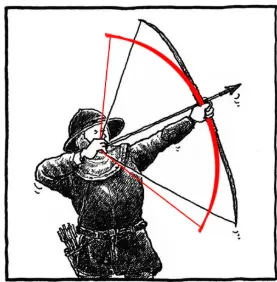
Muscle contracts and pulls on bone up to 10x that of your bodyweight from the calf muscle on the shin bone for example! It pulls on the bone at its attachment points, bending and warping the bone slightly (bone strain), analogous to the way a bow string will bend a bow. Bone remodels along its lines of strain (Wolff’s law), formalised more recently as the “mechanostat”. Below this strain threshold, bone basically doesn’t bother maintaining itself, whilst any loading above – it will sense and build accordingly (in the presence of available energy – not relevant for this discussion).
Muscle contraction compresses and moves joints, pumping synovial fluid through cartilage, feeding it nutrients. Elite weightlifters and long term runners show measurably thicker cartilage in load bearing regions. Cartilage has a different behaviour to most other tissues, however it still has the capacity to adapt in the right conditions, albeit more slowly.
Fascia and aponeurotic (tendon like structures within the muscle) also adapt structurally to load.
So tendon, bone, cartilage and fascia all get their signal from muscle. Look after the muscle as a priority and you will eventually address all of it.
What is the most optimal way to maintain tissue(s) health, structure and mechanical properties (ie. tissue strength and resilience)? Well… it is to train the muscles. And how do we train the muscles optimally? We give them the best opportunity to produce force, which is governed by two fundamental biomechanical relationships.
The force-length relationship
The force-length (or length-tension) relationship. A sarcomere (the smallest contractile unit in a muscle) – produces force through the overlap of actin and myosin filaments forming cross bridges. Too little overlap (muscle too long) or too much (muscle too short) and force producing ability decreases as seen in this image from Dr Lance Brooks’ summary:
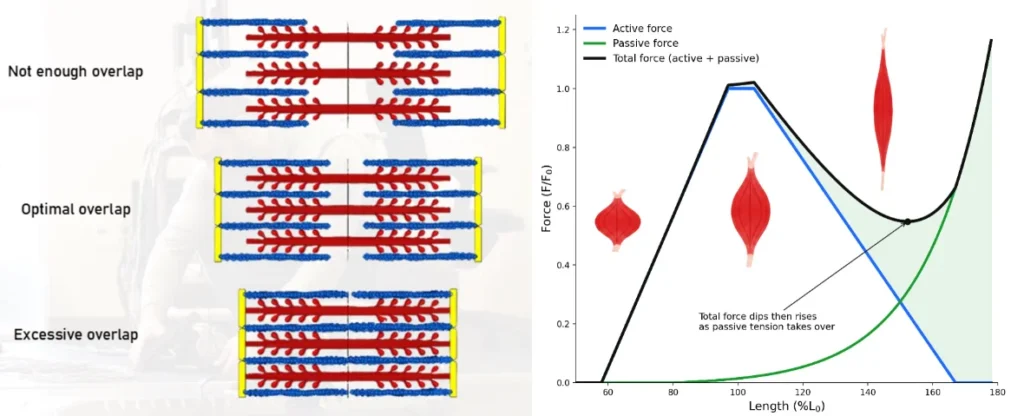
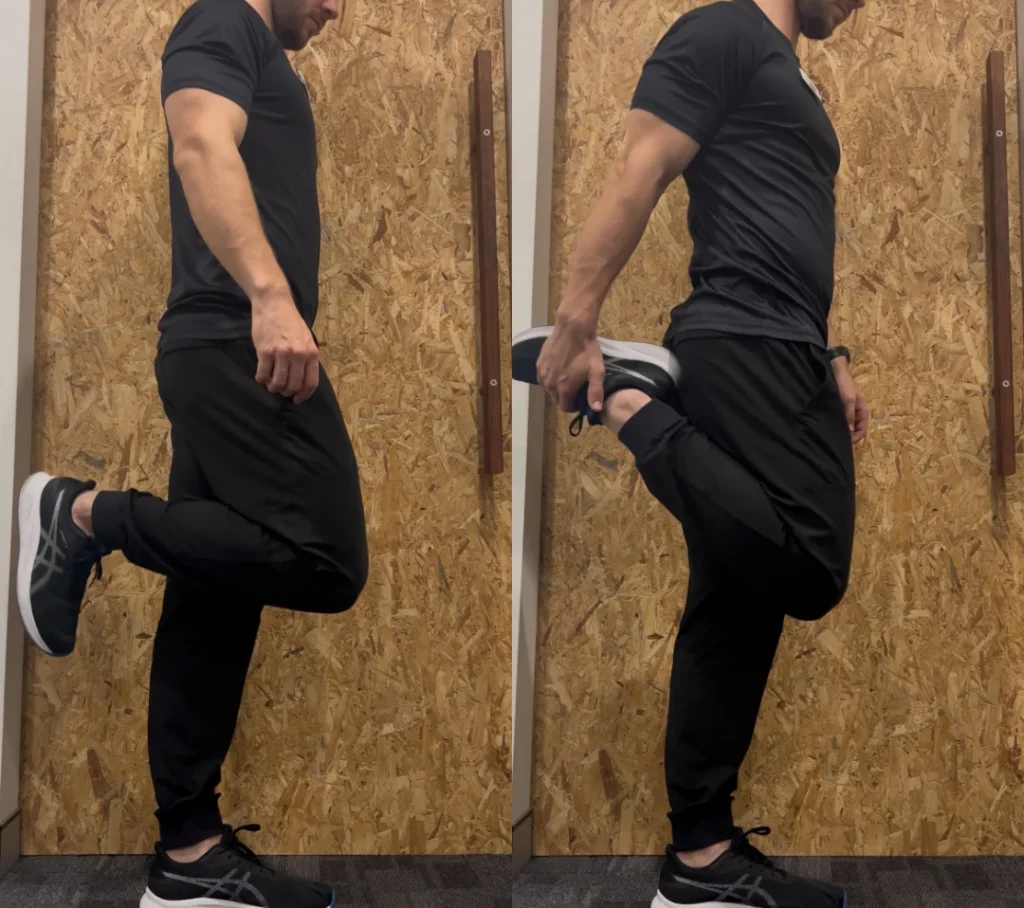
You can actually feel this relationship with a simple test: stand up and try to touch your heel to your bum without your hands or momentum. You won’t get there… not because your knee can’t bend that far, but because the hamstring muscle is so shortened that there is nothing left to give (ie. it can’t produce any more force, to generate more knee bending). This is termed active insufficiency, it directly represents the curve above (without taking into account muscle moment arms). It’s also the reason why it is nonsensical to purposefully train a muscle in this shortened state in a healthy individual, it is simply unable to produce a meaningful amount of force thus will not experience much mechanical tension and will experience suboptimal adaptation (alongside the other tissues aforementioned).
An example of this relationship can be felt with a simple test: stand up and try to touch your heel to your bum without your hands or momentum. You wont get there… not because tour knee cant bend that far, but because the hamstring muscle is so shortened that there is nothing left to give (ie. it cant produce any more force, to generate more knee bending). This is termed active insufficiency, it directly represents the curve above (without taking into account muscle moment arms). It’s also the reason why it is nonsensical to purposefully train a muscle in this shortened state in a healthy individual, it is simply unable to produce a meaningful amount of force thus will not experience much mechanical tension and will experience suboptimal adaptation (alongside the other tissues aforementioned).
The curve above only shows the force the muscle actively makes, though. A stretched muscle also produces passive force (from other molecules and connective tissue), so total tension at longer lengths is active plus passive. That’s why training at longer muscle lengths is getting so much attention, and I’ll come back to it in part 2.
This is where muscles are mind blowing. A single muscle eccentric contraction, due to its passive force producing ability can generate up to 1.5 to 2 times the force as a shortening only contraction. This extraordinary force producing ability allows humans to move in all sorts of different ways.
The force velocity relationship
The second muscle mechanics relationship is the force velocity relationship, described in the 1930’s by AV Hill using isolated bits of muscle. At the level of a single muscle acting at a single joint (ie. the biceps at the elbow), the faster it shortens, the fewer cross-bridges can attach and cycle per unit time, and the less force it produces. Isometric (zero velocity) is right at the top of force production with lengthening under load (eccentric) able to even exceed it. This applies to single muscles acting at single joints and NOT whole body, multi-joint movements (that would be termed the load-velocity relationship)! Tendons, due to their stretch and recoil, allow muscle’s fibres to contract slowly (more optimally) meaning they won’t necessarily move at the same speed as the joint they cross.
This doesn’t mean slow is better, or that we should avoid moving fast. We move fast for different reasons: it means we should train how quickly we can produce force (rate of force development), recruiting our fast-twitch fibres, loading tendon and bone at high strain rates. That’s why the two ways to train below sit side by side.
So how does this relate to health and longevity? Well, if you want the most out of your neuromusculoskeletal system, you know, the thing that allows you to stand up from your chair or climb a flight of stairs, you must challenge it in a way that it can adapt. We can achieve this in 2 fundamental ways: 1. Intent to move fast ie. jumping/running/sprinting and 2. Heavy and slow movements ie. weights training. Everyone can do it.
So, whether you’re a weekend warrior building capacity for Saturday, a budding athlete playing the long game, or someone investing in your future self, the message is the same: your tissues don’t care what you call yourself, they care what you ask of them.
In part 2, I will underpin the adaptations required and a selection of exercises that may help produce these adaptations.
References
Brooks, L. [@lancebrooks_phd]. (2026, June 10). [Infographic]. Instagram. https://www.instagram.com/p/DZK7wJPgIW0/
Frost, H. M. (1987). The mechanostat: A proposed pathogenic mechanism of osteoporoses and the bone mass effects of mechanical and nonmechanical agents. Bone and Mineral, 2(2), 73-85.
Gordon, A. M., Huxley, A. F., & Julian, F. J. (1966). The variation in isometric tension with sarcomere length in vertebrate muscle fibres. The Journal of Physiology, 184, 170-192.
Hill, A. V. (1938). The heat of shortening and the dynamic constants of muscle. Proceedings of the Royal Society of London. Series B, Biological Sciences, 126, 136-195.
Sire Sasa. (2019, February 2). Please remember from now on: Bows bend! [Blog post]. Crap Archery. https://craparchery.blogspot.com/2019/02/please-remember-from-now-on-bows-bend.html