Returning to running post running related injury can be an art and science. There are many variables to consider with regards to how return to run programs are structured and progressed. These can include: commencement date of running, volume and intensity of running, injury related symptoms, athlete’s confidence levels, surface interactions, and the modality of running.
In the past decade there has been an advent in technology that can assist runners of all levels with their return to running efforts. Technologies including anti-gravity treadmills, and body weighted suspension systems, underwater treadmills have been incorporated into the programming of injured runners at an individual and sporting team and federation level.
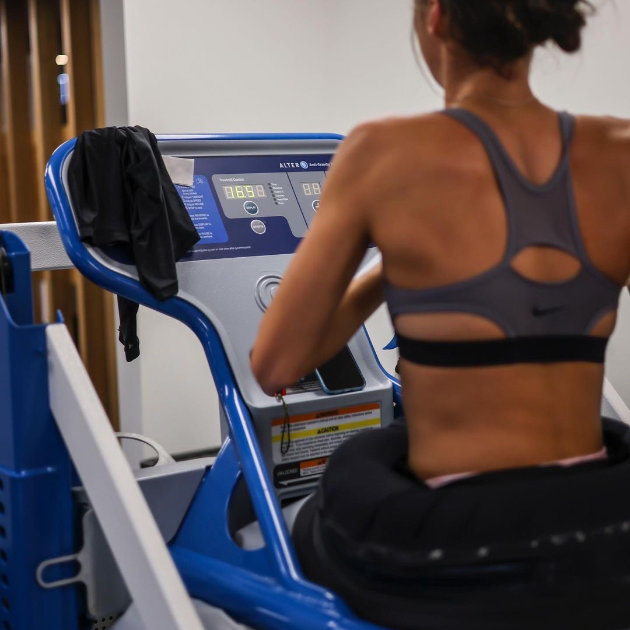
The AlterG is the only modality that does not require a pool or harness, allowing for reductions in body weight by 1% increments to as low as 20% of a runner’s body weight. The AlterG is the main type of lower body positive pressure (LBPP) treadmill on the market.
The origins of the AlterG’s design and development were in aeronautics/space when NASA commissioned an engineer to find a way for astronauts to exercise in a zero-gravity environment. The original design allowed for astronauts to exercise in space by running or walking on a treadmill-allowing for the health benefits of offsetting muscle mass atrophy, slowing bone mineral density losses, and maintaining cardiovascular fitness. Fascinatingly the engineer’s son was successful in reversing the treadmill’s negative pressure, developing the LBPPP for use on earth.
The AlterG has a sealed bag that supports the positive air pressure. The machine has a force plate on the treadmill that calibrates a runner’s weight and the machine accordingly, with the display showing percentage of body weight, speed, and incline.
The bag height can be adjusted on the AlterG. Ideally the bag should be positioned at hip height. Moving the bag up increases support, and moving the bag down decreases support. At 100% body weight the AlterG provides around 6-7% support. Studies have verified the accuracy of the AlterG at between 60 and 90% of full body weight .
How does the AlterG alter running biomechanics?
There has been an emerging body of literature looking at the effect of AlterG running on biomechanics and metabolics.
As would be expected as body weight support increased (i.e. running at a lower percentage of body weight) impact forces across the foot, ankle, and knee have been shown to decrease. These impact forces included reductions in mean, peak, and active peak impact forces.
Some literature findings that looked at the effect of the AlterG on running biomechanics are outlined below:
- Hoffman et al (2011) found that ground reaction forces (GRF) were reduced by 10% at 75% of body weight, and 20% less when running at 50% of body weight.
- Jensen et al (2016) also reported that mean and peak ground reaction forces decreased with greater body weight support- with a greater reduction in GRF at the knee than the ankle, with effects being greater at slower running speeds. Cadence and plantar load was also found to decrease as% running body weight decreased.
In addition to the reduced impact forces with body weight supported running changes in running gait have also been observed, including the below:
- Smoliga et al (2015) reported a shift from rearfoot to forefoot strike when running below 80% of body weight.
- Barnes et al (2017) looked at the effect of increased body weight support on stride length. They reported that stride length was 10% longer at 70% body weight compared to 100% body weight, with an accompanied longer flight time. At 70% of body weight, cadence reduced 3-4%.
How does the AlterG alter metabolic demand?
With regards to the effect of AlterG treadmill running on metabolic demand and performance studies verify that the metabolic demand of running is reduced on the AlterG, most notably when body weight is reduced to less than 50% and running speeds are slower. The following has been scientifically reported:
- Ruckstuhl et al (2010) reported that oxygen consumption for running was significantly reduced by 27% at 66% body weight and 54% at 33% body weight. RPE and heart rate were also reduced.
- Raffalt et al (2013) found that runners ran at similar maximal oxygen consumption on the AlterG compared with treadmill running, but in the AlterG runners were able to run 34.5% longer at maximal capacity.
- Temple et al (2017) reported an oxygen consumption reduction of 30% and improvement in running efficiency of 17% when runners ran 12min sessions at 5,6, and 7miles per hour on the regular treadmill compared with 60% body weight on the AlterG.
- Grabowski et al (2008) found that it was possible to run at similar metabolic output but with lower overall impact forces when running on the AlterG.
It should also be noted that running at 100% body weight on the AlterG requires less oxygen consumption than running on a regular treadmill or over-ground-due to the support from the bag being circa 6-7% of body weight.
How can the AlterG be used for running injury rehabilitation?
Several research groups have shown that as body weight support increased the magnitude of muscle activation decreased, however muscle activation patterns remained similar to over-ground running.
There is somewhat of a paucity of scientific literature looking at the use of body weight supported running and injury rehabilitation.
AlterG have published clinical guidelines for the following conditions including weight bearing progressions as outlined below:
- Lower limb stress injuries (third metatarsal)
- Achilles tendon repair surgery
- ACL reconstruction surgery
- Lateral ankle reconstruction surgery
When the patient commences weight bearing it usually commences at circa 50% body weight, progressing to 80-90% by around the 6 week mark. Body weight was progressed by 10% each week on average, and duration by approximately 10mins each week.
There has however been several case studies and case series looking at the use of the AlterG anti-gravity treadmill as a rehabilitation tool for the following conditions:
- Achilles tendon rupture/insertional repair: Saxena et al (2011) looked at 11 runners assigned to either AlterG or regular rehabilitation. The runners in the AlterG rehab group started running at 70% body weight and progressed to 85% body weight within one month of commencing a return to running, commencing running in the AlterG at just over 13 weeks post surgery. The AlterG group ran over-ground at an average of 17.2weeks (once 85% of running on the AlterG was achieved) while the standard rehabilitation group ran over-ground at 20.7weeks. The authors surmised that running at 85% of body weight may constitute a clinical guideline for commencing outdoors/over-ground running.
- In 2012 Tenforde et al looked at the use of the AlterG for the rehabilitation of a pelvic stress fracture in a 21yr old collegiate runner. The athlete attempted 3 runs at 50-70% BW 3 weeks after diagnosis however experienced pain following these runs. However by 5 weeks the athlete was able to tolerate 3x5mins of jogging, and successfully built session duration and decreased body weight support over the ensuing weeks. By week 8 the runner was able to tolerate 45 minutes of running at 95% BW.
- De Heer (2014) presented a case study looking at the use of the AlterG anti-gravity treadmill for the rehabilitation of a 2:06 marathoner suffering from proximal hamstring tendinopathy (PHT). The runner commenced running at 60% body weight, but spent most of the time at 70-80% body weight. The athlete returned to pre-injury full training status within 4 weeks of running with nil PHT symptoms.
- Moore et al (2010) presented a case study whereby a 52yr old male ultra runner with a lumbar disc herniation who underwent microdiscectomy commenced use of the AlterG 6 days post procedure walking at 50% body weight. The athlete ran 7miles the next day, the following week 60miles progressing to 90% body weight support by week 5. By week 6 the runner was running without pain and was back to over-ground running including trails.
Integrating the AlterG anti gravity treadmill into clinical practice
Body weight supported running can be a useful inclusion for running related injury rehabilitation. It provides an alternate to water running, cross-training, cycling in early rehabilitation, or for return to run programming. Body weight supported running such as the Lever system or AlterG anti gravity treadmill allows for systematic increasing exposure to running loads, as opposed to transitioning from rest straight to over-ground 100% body weight running.
The chief benefit in a rehabilitation setting being that body weight supported running results in decreased impact tissue forces, including average and peak impact forces. This can be very useful for impact related injury rehabilitation. Conditions where reducing tissue loads on return to running can be advantageous include running related tendinopathies, bone stress injuries, and joint related concerns.
It should be remembered however that body weight supported running has been shown to alter biomechanics. People change the way they run when body weight is supported. Increased stride length, flight time, and a slightly decreased cadence have been observed in the scientific literature. These biomechanical effects are more pronounced with greater body weight support.
From a non rehabilitation perspective body weight supported treadmill running may be used if a reduction in metabolic demand was deemed to be favourable for a workout or training block. In essence this allows the athlete to extend the length of workouts with less overall metabolic demand.

Brad Beer
APA Titled Sports & Exercise Physiotherapist (APAM), POGO Founder
Book an Appointment with Brad here.
Featured in the Top 50 Physical Therapy Blog
References
- Hoffman (et al 2011). Physiological responses to body weight: supported treadmill exercise in healthy adults. Arch Phys Med Rehab
- Jensen, B. R., Hovgaard-Hansen, L., & Cappelen, K. L. (2016). Muscle activation and estimated relative joint force during running with weight support on a lower-body positive-pressure treadmill. Journal of applied biomechanics, 32(4), 335-341.
- Smoliga, J. M., Wirfel, L. A., Paul, D., Doarnberger, M., & Ford, K. R. (2015). Effects of unweighting and speed on in-shoe regional loading during running on a lower body positive pressure treadmill. Journal of biomechanics, 48(10), 1950-1956.
- Barnes, K.R., Janecke, J.N. Physiological and Biomechanical Responses of Highly Trained Distance Runners to Lower-Body Positive Pressure Treadmill Running. Sports Med – Open 3, 41 (2017). https://doi.org/10.1186/s40798-017-0108-x
- Ruckstuhl, H., Schlabs, T., Rosales-Velderrain, A., & Hargens, A. R. (2010). Oxygen consumption during walking and running under fractional weight bearing conditions. Aviation, Space, and Environmental Medicine, 81(6), 550-554.
- Raffalt, Peter C., Line Hovgaard-Hansen, and Bente Rona Jensen. “Running on a lower-body positive pressure treadmill: VO2max, respiratory response, and vertical ground reaction force.” Research quarterly for exercise and sport 84.2 (2013):213-222.
- Temple, Corey, et al. “Run economy on a normal and lower body positive pressure treadmill.” International Journal of Exercise Science 10.5 (2017): 774.
- Grabowski, Alena M., and Rodger Kram. “Effects of velocity and weight support on ground reaction forces and metabolic power during running.” Journal of applied biomechanics 24.3 (2008).
- Saxena, Amol, and Allison Granot. “Use of an anti-gravity treadmill in the rehabilitation of the operated achilles tendon: a pilot study.” The journal of foot and ankle surgery 50.5 (2011): 558-561.
- Tenforde, A. S., Watanabe, L. M., Moreno, T. J., & Fredericson, M. (2012). Use of an antigravity treadmill for rehabilitation of a pelvic stress injury. PM&R, 4(8), 629-631.
- De Heer, H. D., Kline, J. R., & Charley, B. (2020). Anti-gravity treadmill training for prevention and rehabilitation of running injuries. In Clinical Care of the Runner (pp. 113-130). Elsevier.
- Moore, M. N., Vandenakker-Albanese, C., & Hoffman, M. D. (2010). Use of partial body-weight support for aggressive return to running after lumbar disk herniation: a case report. Archives of physical medicine and rehabilitation, 91(5), 803-805.