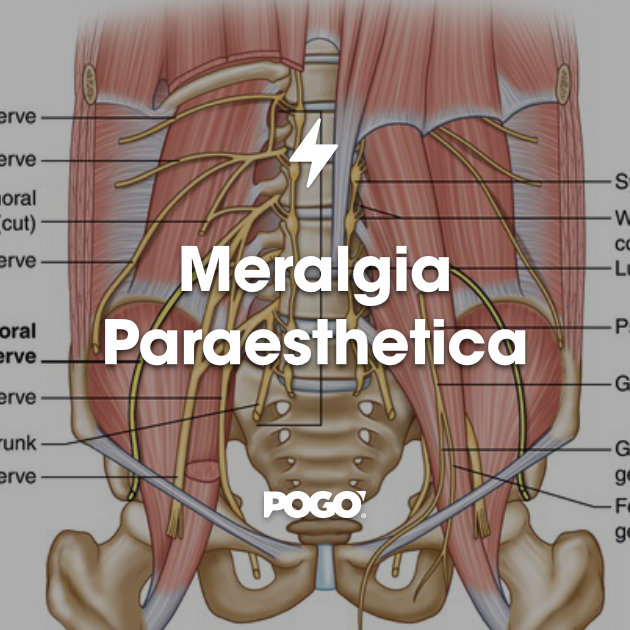
Also known as Bernhardt-Roth syndrome, Meralgia Paraesthetica is a syndrome of altered/abnormal sensations like tingling, numbness or burning and, pain, or a combination of such in the upper front side (antero-lateral aspect) of the thigh associated with compression/entrapment of the lateral femoral cutaneous nerve (LFCN) (2). These symptoms are often worsened with prolonged standing, walking, and even lying straight, and are subsequently relieved by sitting (2). Meralgia Paraesthetica was first described in 1885, by the German surgeon Werner Hager, and later named “meralgia,” from the Greek words “meros” meaning thigh and “algos” meaning pain (2).
Anatomy

Image: Lateral Femoral Cutaneous Nerve (2)
Detailed Description:
For those who want to know more detail – the LFCN arises from L2 and L3 nerve roots coursing between the superficial and deep parts of the psoas and around the pelvis on the iliacus muscle between two layers of fascia (2). It then travels through an “aponeuroticofascial tunnel” from the iliopubic tract to the inguinal ligament (IL), under the IL or through a split in its most lateral part at the anterior superior iliac spine (2). About 10 cm below the IL, it emerges through the superficial fascia of the thigh, divides into anterior and posterior branches, and ends in the skin of the anterolateral thigh (2). The smaller posterior branch that innervates the greater trochanter area and a larger anterior branch, which innervates the anterolateral thigh to the knee (2).
Summary:
The lateral femoral cutaneous nerve is a sensory nerve that is susceptible to compression as it courses from the lumbosacral plexus, through the retroperitoneum, under the inguinal ligament, and into the subcutaneous tissue of the thigh (2).

Image: Variable anatomical course of the LFCN (1)
Anatomical Variations:
- Fused with the genitofemoral nerve (GFN) in about 2 %: if so, there is increased vulnerability to lumbar sympathetic block.
- Intra–abdominal branching: has one vertebral origin and one distributing branch at the level of the inguinal ligament in 86 % of cases.
- Site at which the LFCN leaves the abdomen:
- A (4 %) = posterior to ASIS, across the iliac crest.
- B (27 %) = medial to the ASIS, superficial to the origin of the sartorius.
- C (23 %) = medial to the ASIS, within the origin of the sartorius muscle.
- D (26 %) = medial to the origin of the sartorius muscle, between its tendon and the thick fascia of the iliopsoas muscle, deep to the inguinal ligament.
- E (20 %) = the most medial origin, also deep to the inguinal ligament, but superficial to the iliopsoas fascia
- Distance from the ASIS at the level of the inguinal ligament: 1.4 ± 1.5 cm with a range of 2.3 cm lateral to 6.2 cm medial
- Inguinal branching: As many as five branches identified; in 8 of 29 cadavers (28 %), the LFCN branched before traversing the inguinal ligament.
- Angle between the pelvic and femoral portions: 100 ± 10°
- Relationship to the sartorius muscle: exit through the muscle (11/50 = 22 %) or its tendon of origin (24/104 = 23 %)
- Relationship to the superficial thigh fascia: 88 % are deep to the superficial fascia below the ASIS, 3 % are superficial to it, and 9 % were not found.
- Thigh branching: 27/50 (54 %) bifurcation to anterior and posterior branches; 18/50 (36 %) had no posterior branch. The area of the skin over the lateral and anterior thigh innervated by the LFCN is highly variable (2)
Signs/Symptoms:
- Altered/abnormal sensations (e.g. tingling, numbness or burning) in upper lateral thigh – worsened with prolonged standing, walking or ipsilateral hip extension
- Tenderness over the anterior superior iliac spine (ASIS)
- Nil change in strength of thigh muscles – LFCN is entirely sensory in function (2,4)

Image: Cleveland Clinic
Types of Meralgia Paraesthetica:
1. Idiopathic
Primary or Idiopathic Meralgia Paraesthetica (MP) is the most common form of MP and occurs when there is no distinct event or obvious cause for the entrapment of the LFCN (2,4). It commonly presents slowly, progress gradually, and persist without intervention.
Despite there being no distinct cause in Idiopathic MP, several mechanical and metabolic risk factors have been identified that increase a person’s chance of developing the syndrome (3,5). These include:
- Obesity/ High BMI
- Diabetes mellitus
- Advanced Age
- Reduced distance between LFCN and ASIS – see anatomical variations above
- Excessive Alcohol Consumption
- Wearing tight belts/garments
- Use of tight seat belts/braces
- Leg length changes
- Scoliosis
2. Iatrogenic – Post Surgery/Trauma
The second form of Meralgia Paraesthetica occurs secondary to direct trauma to the pelvis or anterior thigh (e.g. motor vehicle accident), or complications peri and post-surgeries of the lumbar spine, hip and pelvis (e.g. injury to the LFCN during operation, or post-operative swelling/scar tissue formation impacting the path of the LFCN) (2,4).
Diagnosis
Other conditions that can present similarly to MP that should be ruled out before a diagnosis of MP is made include:
- L2 or L3 radiculopathy (more common)
- Pelvic or iliac crest mass
- Chronic appendicitis
- Superior gluteal nerve entrapment
- Femoral neuropathy
- Hemangioma of pelvis
- Inguinal hernia
- Hip joint pain
- Greater trochanter bursitis
A diagnosis of Meralgia Paraesthetica should be made by a skilled clinician such as a Physiotherapist or Medical Practitioner. However, a combination following signs is highly suggestive of a diagnosis of Meralgia Paraesthetica:
- Altered/abnormal sensory changes over the anterolateral thigh with no motor findings
- Tenderness and Tinel’s sign adjacent to the ASIS
- Symptoms aggravated by prolonged standing, walking or extension of the hip and relieved by positions that comfortably flex the hip (sitting)
- Ultrasound-guided injection to the LFCN that provides relief from symptoms
- MRI (3-tesla) has recently been shown to have a 94% predictive value in diagnosing MP
Treatment
High quality evidence for/ consensus on optimal treatment of Meralgia Paraesthetica is considerably lacking (4). Initial treatment will usually focus on non-surgical options listed below:
- Non-steroidal anti-inflammatories (NSAIDS)
- Protection of the area
- Avoidance of aggravating positions/movements that compress the LFCN
- Physiotherapy
- Radio-frequency ablation
- LFCN block (4)
Meralgia Paraesthetica can often spontaneously resolve – especially with the appropriate management from a Physiotherapist/Medical Practitioner (2,4). However, LFCN neurolysis and resection are optional interventions in cases where non-surgical management has failed (4). Neurolysis has shown favourable outcomes in individuals up to 4 years following surgery, and resection has also shown favourable results despite the complete loss of sensation in the anterolateral thigh that occurs after surgery (4).
Meralgia Paraesthetica presents variably person to person, as such it is difficult to obtain high quality research on its causes and optimal treatment strategies. As always, if you are currently experiencing any of the above signs/symptoms suggestive of Meralgia Paraesthetica, it is best to seek the care and guidance of a qualified professional such as a Physiotherapist or Medical Practitioner.
If you have any questions or queries – email me at o.crossley@pogophysio.com.au

Oliver Crossley (APAM)
POGO Physiotherapist
Featured in the Top 50 Physical Therapy Blog
References
- Moritz, Thomas, Helmut Prosch, Dominik Berzaczy, Wolfgang Happak, Doris Lieba-Samal, Maria Bernathova, Eduard Auff, and Gerd Bodner. “Common anatomical variation in patients with idiopathic meralgia paresthetica: a high resolution ultrasound case-control study.” Pain physician 16, no. 3 (2013): E287-93
- Witkin, Lisa Rochelle, Amitabh Gulati, Tiffany Zhang, and Helen W. Karl. “Lateral Femoral Cutaneous Nerve Entrapment.” In Peripheral Nerve Entrapments, pp. 667-681. Springer, Cham, 2016
- Parisi, Thomas J., Jay Mandrekar, P. James B. Dyck, and Christopher J. Klein. “Meralgia paresthetica: relation to obesity, advanced age, and diabetes mellitus.” Neurology 77, no. 16 (2011): 1538-1542
- Cheatham, Scott W., Morey J. Kolber, and Paul A. Salamh. “Meralgia paresthetica: a review of the literature.” International journal of sports physical therapy 8, no. 6 (2013): 883