
Pain is a complex, personal experience that is more than just a physical sensation. It is influenced by biological, psychological, and social factors.
In this blog post, we’ll explore three key types of pain: nociceptive, nociplastic, and neuropathic pain. By understanding these differences, both clinicians and patients can work together to create more effective management strategies.
Pain
A modern definition from the International Association of Pain (IASP) defines pain as an unpleasant sensory and emotional experience associated with, or resembling that is associated with, actual or potential tissue damage. Important to note alongside this definition is pain is always a personal experience that is influenced to varying degrees by biological, psychological, and social factors. Pain and nociception are different phenomena. Pain cannot be inferred solely from activity in sensory neurons and we discuss this more below. A person’s report of an experience of pain should be respected and an inability to communicate does not negate the possibility of experiencing pain. Although pain usually serves an adaptive role, it may have adverse effects on function and social and psychological well-being.
Nociceptive Pain
Nociceptors are high-threshold sensory receptors of the peripheral somatosensory nervous system which are capable of transducing and encoding noxious stimuli. Importantly these are not pain receptors, our body does not have pain receptors. Nociception (IASP) is the neural process of encoding noxious stimuli (Raja et al., 2020). As a result of this we can have be autonomic responses (e. g. elevated blood pressure) or behavioural changes (motor withdrawal reflex such as touching something hot) whilst pain sensation is not necessarily implied. Nociceptive Pain (IASP): Pain that arises from actual or threatened damage to non-neural tissue and is due to the activation of nociceptors. Examples include the sharp pain from a cut or the throbbing ache after a sprain. This type of pain is a critical protective mechanism designed to alert the body to harm (IASP).
Key Features
- Source: Triggered by injury, inflammation, or tissue damage.
- Sensation: Often described as aching, throbbing, or sharp, less likely parasthesias, follows normal healing timeframes and is more often mechanical and intermittent. Irritability – is it an accurate representation of the task performed
- Purpose: Serves as an essential warning system for the body.
- Assessment: Clinicians use patient-reported pain scales (e.g., the Numerical Pain Rating Scale), body charts, and physical examinations to evaluate nociceptive pain and determine if symptoms are consistent with the state of the tissue.
Management Strategies
- Medical Management: Non-steroidal anti-inflammatory drugs (NSAIDs), paracetamol, and occasionally short-term opioids may be used.
- Non-Medical Approaches:
- Advice and Education – Building understanding of condition, sequence of events, and expectations for recovery
- Exercise Therapies
- General Exercise, Strengthening Exercise, Specific Motor Retraining Approaches, Graded or Functional Training Approaches, Yoga or Pilates
- Manual Therapies
- Mobilisation, massage
- Electrotherapies
- Transcutaneous Electrical Stimulation (TENS), Interferential Therapy (IFT)
- Thermal Modalities
- Heat, cryotherapies
- Adjunct Therapies
Nociplastic Pain
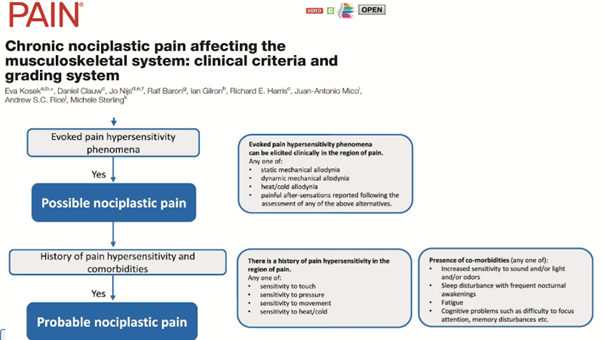
Nociplastic pain describes pain that arises from altered nociception without clear evidence of actual tissue damage or nerve injury. This pain type is often seen in conditions like fibromyalgia, chronic back pain, and migraines, where the nervous system’s processing of pain signals is disrupted (Nijs et al., 2021). The pathophysiology is debated but is often linked with central sensitization in which pain amplification and hypersensitivity occur in the central nervous system. Others authors say that Nociplastic Pain is not interchangeable with central sensitisation as it affects central or peripheral nervous systems. Pain often occurs with hypersensitivity, allodynia (pain to non-painful stimuli) or disproportionate pain responses (highly irritable). Criteria for definitive nociplastic pain is not determined yet because no confirmatory test has been established (Yoo & Kim, 2024).
Key Features
- Mechanism: Involves peripheral and or central sensitization – a process where the nervous system becomes hypersensitive, leading to an increased pain response in the absence of ongoing tissue damage.
- Sensation: Can be widespread and persistent. Patients may experience allodynia (pain from normally non-painful stimuli) or hyperalgesia (exaggerated pain from normally painful stimuli).
- Assessment: Requires comprehensive evaluation including detailed patient history, physical examinations, and screening questionnaires to capture associated symptoms such as fatigue, sleep disturbances, and cognitive difficulties (Yoo & Kim, 2024). Clinical Sensory Testing (CST) is used to assess the effects of light tough, pressure, temperature and sharp pressure which will often show increased sensitivity. Asking around other conditions such as fibromyalgia, irritable bowel, migraine and chronic fatigue. Assessment is often modified due to pain hypersensitivity,
Management Strategies
- Education: Helping patients understand that their pain stems from altered processing rather than active tissue damage. Important to remember that pain can be from more than one type of pain; nociplastic and nociceptive for example.
- Therapeutic Approaches: Graded exercise, cognitive behavioural therapy, and medications such as certain antidepressants or anti-epileptic drugs may help modulate pain signalling.
- Multidisciplinary Care: Combining physical therapy, psychological support, and lifestyle adjustments tends to yield the best outcomes.
Neuropathic Pain
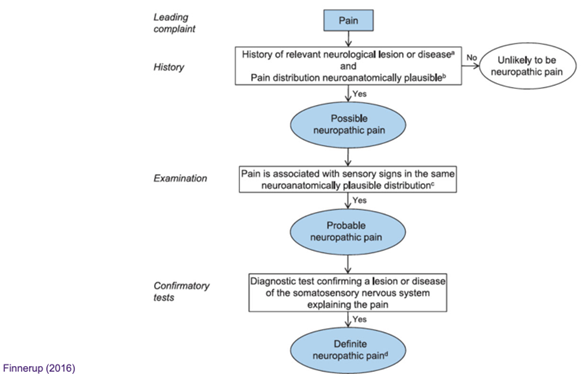
Neuropathic pain results from a lesion or disease affecting the somatosensory nervous system. Neuropathic pain is a clinical description (and not a diagnosis) which requires a demonstrable lesion or a disease that satisfies established neurological diagnostic criteria. Common examples include diabetic neuropathy, postherpetic neuralgia, and trigeminal neuralgia (IASP, 2011). In musculoskeletal physiotherapy commonly this ‘lesion’ is nerve compression at the spine or a peripheral nerve.
Key Features
- Mechanism: Caused by direct injury or pathological changes within nerve fibres, leading to abnormal sensory processing.
- Sensation: Often described as burning, shooting, electric shock-like, or tingling. Patients may also report numbness or heightened sensitivity.
- Assessment: A thorough history and physical exam are essential. Additional tests such as quantitative sensory testing, nerve conduction studies, or imaging may be used to confirm nerve damage. PainDETECT and LANNS questionnaires are often used.
- Diagnosis: The term “neuropathic pain” is a clinical descriptor that necessitates both a patient’s reports of symptoms and confirmatory tests to identify an underlying lesion or disease in the nervous system (Finnerup et al., 2016).
Management Strategies
- Medications: Anticonvulsants (e.g., gabapentin, pregabalin), certain antidepressants (e.g., duloxetine), and topical agents can be prescribed.
- Interdisciplinary Care: Integrating pharmacological treatment with Physiotherapy and psychological support often leads to improved outcomes.
- Spinal Drug administration -Nerve block
- Ablative techniques – Minimally invasive procedures that involve coagulation necrosis of afferent nociceptive signals via high- frequency waves
- Stimulation techniques (TENS, IFT, Spinal implants)
Conclusion
Understanding the differences between nociceptive, nociplastic, and neuropathic pain is crucial for effective pain management. While nociceptive pain acts as a warning signal for potential tissue injury, nociplastic pain involves altered pain processing without clear tissue damage, and neuropathic pain originates from nerve injury or disease. Many patients may experience overlapping features of these pain types, highlighting the need for individualized, multidisciplinary treatment approaches. By recognizing and addressing these distinct pain mechanisms, healthcare professionals and patients alike can work towards better diagnosis, treatment, and overall management of chronic pain conditions.

Lewis Craig (APAM)
POGO Physiotherapist
Masters of Physiotherapy
Featured in the Top 50 Physical Therapy Blog
References
- International Association for the Study of Pain (IASP). (n.d.). Terminology. Retrieved from https://www.iasp-pain.org/resources/terminology/
- Raja, S. N., Carr, D. B., Cohen, M., Finnerup, N. B., Flor, H., Gibson, S., … & Wager, T. D. (2020). The revised definition of pain: Report of the IASP Task Force on the Taxonomy of Pain. Pain.
- Nijs, J., et al. (2021). Nociplastic pain criteria or recognition of central sensitization? Pain phenotyping in the past, present and future. Journal of Clinical Medicine, 10(15), 3203.
- Yoo, Y.-M., & Kim, K.-H. (2024). Current understanding of nociplastic pain. The Korean Journal of Pain, 37(2), 107–118. https://doi.org/10.3344/kjp.23326.
- Kosek, E., Clauw, D., Nijs, J., Baron, R., Gilron, I., Harris, R. E., Mico, J.-A., Rice, A. S., & Sterling, M. (2021). Chronic nociplastic pain affecting the musculoskeletal system: clinical criteria and grading system. Pain (Amsterdam). https://doi.org/10.1097/j.pain.0000000000002324.
- Finnerup, N. B., et al. (2016). Neuropathic pain: an updated grading system for research and clinical practice. Pain, 157(6), 1099-1104.