
Running injuries typically occur from the interaction of numerous contributing factors. When training loads exceed the body’s physical capacity to handle it for a prolonged period, a running injury can occur. To help simplify this complex interaction it is helpful to group factors into those that affect the ability of the body to handle load or training stress and those that influence loads placed upon the body. By better understanding what these factors are and how they interact we aim to reduce the risk of injury.
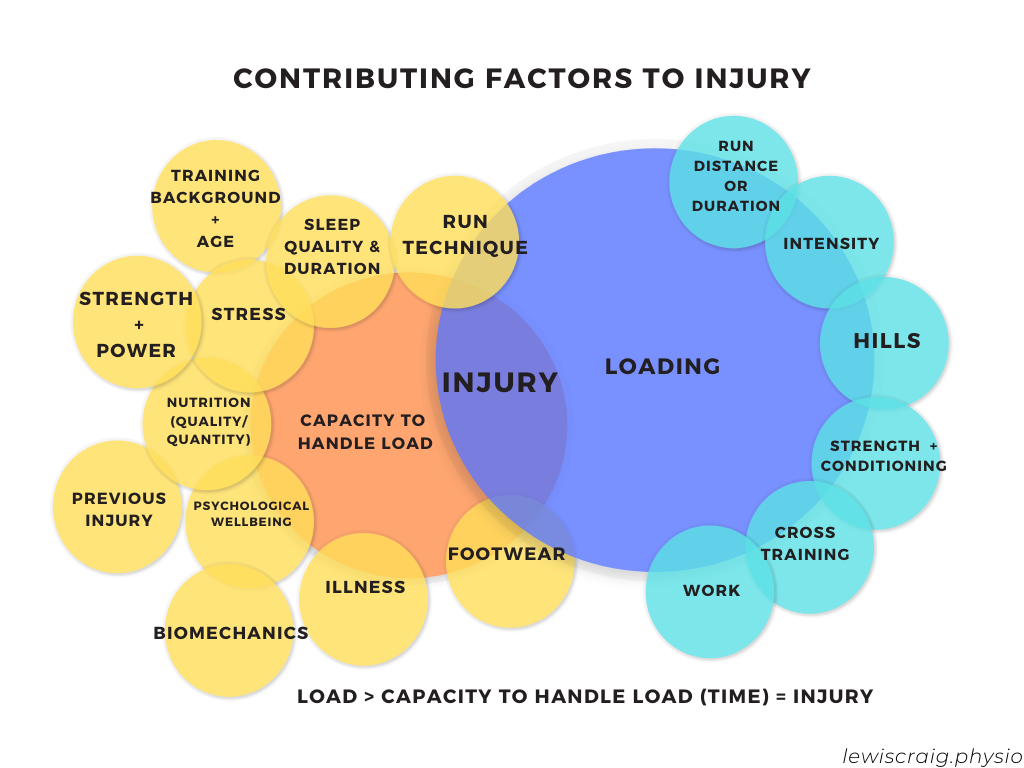
For a runner the most basic injury equation states; when the LOAD placed on the runner is GREATER THAN their CAPACITY TO HANDLE LOAD for a prolonged period of TIME, the result is an INJURY. Often an athlete places themselves at a level of loading that is more they can handle for a short period of time to increase adaptations, termed overreaching (or functional overreaching). The difference there is the intentional nature of this and the short term (extra) recovery window that is necessary for these adaptations to occur.
Factors that influence LOAD
LOAD is the total amount of physical work completed (external load) and the body’s physiological and perceived response to it (internal load). The same external load may have different perceived responses due to factors such as sleep, illness and fatigue:
- Run Distance or Duration
- Running Intensity (RPE or HR) – how much volume of running is done at various intensities. Higher volumes of higher intensity running carries an increased injury risk
- Vertical Metres /Hills
- Cross Training – other forms of training outside of running will also have an external and internal load component such as cycling and swimming
- Strength and conditioning – factors associated with gym training (reps, sets, tempo, weight, rest, %RM)
- Work, study and activities of daily living (ADLs) still place load on the body and over the course of a day or a week theses can be quite significant and should be considered when looking at the overall factors for injury
Factors that influence capacity to handle LOAD
- Injury History – A previous injury is a strong risk factor for development of a running related injury. Following injury there is typically an increased risk of re-injury (risk of having that injury again) and subsequent injury (a new related injury to a different site)
- Training Age/Background – longer training history and higher long term training loads are protective against injury
- Sleep – Increased sleep duration and improved sleep quality in athletes are associated with improved performance and competitive success (Watson 2017)
- Illness – decreases the ability to handle the same loading response
- Psychological Factors (Stress, Anxiety, Depression) – Athletes who possess higher psychological distress are more likely to get injured (Putukian 2016). Importance of employing techniques to manage stress and anxiety
- Nutrition – Intake needs to match the demands of sustaining everyday life and training volume. Avoid low energy availability which occurs in 21-58% of runners (recreational and elite) and has a negative effect of performance and health
- Running Technique – Overstriding is linked to numerous injuries particularly PFP and MTSS
- Biomechanics – the way someone moves dictates where load travels, the amount and direction of load (bone, muscle). For example bony injuries have been associated with greater average vertical loading, higher peak acceleration, higher peak adduction, knee internal rotation, tibial internal rotation, rear foot eversion during gait (Tenforde, et al, 2016)
- Strength, Endurance, Power – The body’s physical characteristics can have protective effects against many injuries (bone, PFP, ITB, strains) and improve fatigue resistance
- Bone mineral density – low bone mineral density increased the risk of bone stress injuries. This is closely related to low energy availability, Calcium and Vit D levels. The importance is placed on activities that can increase bone mineral density such as jumping
Putting it all together
Runners that pay attention to both training loads and factors that influence their ability to handle load, are putting the right steps in place to reduce injury risk. Training load often takes most of the focus, yet many runners will get injured with unchanged training loads but a decreased ability to handle training load through a combination of reduced dietary intake, reduced sleep and an increase in stress.
My advice to runners is to reduce training load errors and try to stay consistent with small gradual changes over time, fuel well (if in doubt speak to a dietician), prioritise sleep and lots of it, consider the role overall stress plays in your training and where possible try add some strength work into your regular schedule.

Lewis Craig (APAM)
POGO Physiotherapist
Masters of Physiotherapy
Featured in the Top 50 Physical Therapy Blog