Running Technique Principle 5: Utilise Your Natural Springs
The below is an excerpt from my Amazon Running & Jogging Bestseller You CAN Run Pain Free! Available on Amazon in Kindle or digital versions HERE, or in physical print HERE.
The 5th Principle of Great Running Technique
The fifth principle to running with great technique is to utilise what I refer to as a runner’s ‘natural springs’. The same anatomical foot and leg structures that assist in lessening the loads on the legs on impact, such as the muscles, tendons and fascia, also assist with propulsion.
So when a runner over-strides and subsequently heel strikes, not only are they by-passing their own shock absorbers they are also in effect bypassing their body’s very own natural springs. The natural springs are the tendon-related structures in the foot and lower leg, including the Achilles tendon, calf muscle complex, and plantar fascia of the foot. When a runner lands on their mid- or forefoot, these natural spring structures generate energy and propulsion as they are stretched and then ‘released’.
Natural springs r tendon-related structures in the foot & lower leg eg the Achilles tendon, calf & plantar fascia of the foot @pogophysio Share on X
Think of how a rubber band behaves when stretched. It stretches first before it then ‘snaps’ or recoils back to its original length. The rubber band releases energy as it ‘snaps back’. This principle in biomechanics is known as ‘elastic recoil’.
Elastic recoil applies to the tendons of the human body in the same way that it applies to a rubber band. The same energy that is created by a rubber band recoiling is also generated by the plantar fascia of a runner’s feet, the Achilles tendon, and the tendons in the calf complex. This occurs when a runner impacts the tendons stretch as they absorb load, before they recoil and provide the runner with propulsion.
Elastic recoil applies to the tendons of the human body in the same way that it applies to a rubber band #running @pogophysio Share on X
Elastic Recoil Exercise
In order to appreciate the principle of elastic recoil at work, Peter MacGill (author of Build Your Running Body) suggests that you tap your index finger on your thigh as hard as you can. Go on, try it! Now take your other hand and pull your index finger back as far as it will go before releasing it. I’m sure your finger on this hand hit your thigh much harder than the muscle-only generated thigh tapping. This is due to the elastic recoil and energy stored in the finger that was bent backwards before it was released to ‘slam’ into the thigh.
Structurally, tendons can undergo stretching or deformation of somewhere between 4 and 6 per cent of their original length. When at rest, the tendon fibres, called collagen, run parallel in wavy lines (think of rolling hills in the country-side). Under load (such as at the time of foot impact), the collagen fibres are aligned as they straighten and store energy. As the lower limb muscles contract the tendons then release their stored up energy. Amazingly, the recoil generated by a runner’s leg tendons under the weight bearing or ‘stance’ phase of the gait cycle provides up to 50 per cent of the propulsive forces required for each stride (15).
This elastic energy is released as kinetic (movement producing) energy during the ‘toe off ’ part of the running cycle. Elastic recoil requires very little energy, and the good news is that it is available for us to use as runners – unless, of course, we bypass these springs by over-striding or running with less than an ideal technique.
When a runner over-strides, they inadvertently rob themselves of this free propulsive energy. Efficient runners store energy from one stride to the next and release it for push off. If it appears as though these runners have springs in their shoes, it is because they actually do!
When a runner overstrides they inadvertently rob themselves of this free propulsive energy #running #technique Share on X
What body frames tell us about tendons
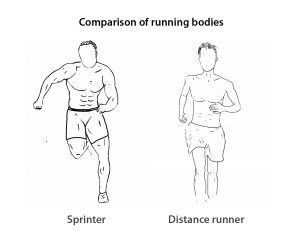
The role that our tendons play in efficient and sustained distance running is evidenced by the body frames of elite distance runners. Typically, an elite distance runner’s frame is composed of very little muscle mass, leaving just bones and tendons as the main propulsive structures. The fact that such a large proportion of their body mass is tendon tissue highlights the importance of tendons in fast and economical running.
When we compare the body shape of the distance runner to that of a sprinter, we can see marked differences. Notably, sprinters are very bulked up with large muscle masses. Sprinters require a large muscle mass for fast sprinting in order to generate power. While they transfer all the force produced by the muscle onto the bones that the muscle will act on, having large muscle mass overrides the effect of tendons.
Stiff tendons
In order to run pain and injury free, and also faster, it is also helpful to have ‘stiff ’ tendons. Stiffer tendons are able to store more energy because greater energy is required to stretch them. This greater energy is stored in the tendons and released at toe off as the muscles of the calf and lower leg contract. To improve the elastic recoil of your lower limb tendons you need to make your tendons stiffer. This can be achieved by strengthening the fibres that make up the tendons with exercises such as single leg calf raises.
PRO TIP: I recommend that all runners perform 30-50 single calf raises a day. Click HERE to view this exercise to view this exercise (Single leg calf raises).
In order to optimise the utilisation of your natural springs, try the following:
- Do not over-stride. Run with a cadence of 90 steps/min. This will ensure your foot lands on the mid- or forefoot whereby the Achilles tendon, plantar fascia, and other lower limb tendons are stretched and store up energy. This stored energy when released at toe off will give a ‘free push’ and ‘free speed’. (Running with a cadence of 90 steps/min also minimises a runner’s foot contact time. The aim of every runner should be to minimise foot contact time in order to decrease the injurious effects of greater lower limb loading rates that result from with prolonged foot contact time.)
Click HERE to read about running with the correct turn-over rate.
- Practise the ‘two-legged hop’ drill. With feet shoulder-width apart, practise bouncing up and down very quickly, landing on the balls of the feet. Aim to bounce as quickly and lightly as you can. Bounce for 30 seconds and repeat three times. This drill teaches your body to land on the maximum tendon utilisation. This drill is best completed before the start of each training run to reinforce the use of your natural springs. Click HERE to watch a video of this drill.
- Incorporate some ‘plyometric training’. Plyometrics evolved in the early 1980s when they were used by Soviet track and field athletes. Plyometric training involves exercises where a runner or athlete moves from a muscle stretched position, to a contracted muscle position, and then back to a muscle lengthened position. Exercises such as box jumps, squat jumps, high skipping, and bounding are examples of plyometric training. Here are some examples of plyometric training you can add to your training: Bounding for 60 metres. Spring off the toes as you project yourself forwards at an angle of 20 to 30 degrees. Repeat three times.
- Sets of eight box jumps. Jump up onto a box at least 40 centimetres in height, and then back down. Try three sets with a two-minute break between sets.
- Sets of five squat jumps. Simply squat down as far as you can and then spring forth as you explode up into the air before landing in a squat position to finish. Try three sets of good quality reps.
- Incorporate some hill sprints. The hill must be steep and short. Run ten reps of the hill with two minutes recovery between sets. The sprint should be between 8 and 12 seconds. Aim for three sets. (See the following section for more on running hills.)
All the best with your running. If you have any questions or comments please leave them below.
Brad Beer (APAM)

Physiotherapist, Author, Founder POGO Physio
References
15. Magill, P. 2014. ‘Recoil: running’s superpower: find free energy for your stride with these six training exercises’. Running Times. http://www. runnersworld.com/race-training/recoil-runnings-superpower. Accessed 8 October 2014.