How Heel Spur Presents
- Do you have pain under your heel? Does the pain persist after some exercise?
- Is the pain most intense when you begin to walk, or weight bear through your foot after a period of rest (e.g. waking up in the morning)? Does it feel like you’re standing on a nail?
- Does the pain limit your ability to walk?
- Can you feel a small bony lump in the tender area under your heel?
If you are experiencing these symptoms you may suffering from heel spur(s).
How Heel Spur is Diagnosed
Your physiotherapist can diagnose for heel spur based on the symptoms you present with, a full history of the pain and a physical examination. Your physiotherapist may examine you for:
- Abnormal walking (or gait) patterns
- Abnormal or suboptimal biomechanics or loading of the foot
- Observe for any weakening of the muscles and heel pad of the affected foot in comparison to the non-affected foot
- Feeling (palpating) for pain, tenderness and the presence of bony spurs
Medical imaging investigations such as a plain X-Ray can help your clinician confirm the presence of bony spurs and rule out heel fractures.
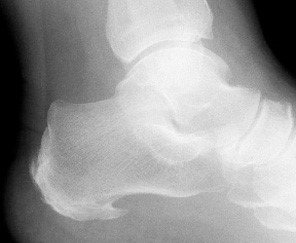
X-Ray showing a spur underneath the calcaneus (source: WikiMedia Commons)
Causes of Heel Spur
The formation of heel spurs often goes hand-in-hand with plantar fasciitis. Both are caused by abnormal biomechanics of the foot, where it is constantly in excessive pronation, and placing extra stress on the underside of the heel bone. The extra stress causes tears to the plantar fascia and other soft tissues around the heel.
The formation of heel spurs often goes hand-in-hand with plantar fasciitis. #performbetter @pogophysio Share on XThe body’s natural protective mechanism is to form calcium deposits at the site of the extra stress, or the healing site of injured plantar fascia. These calcium deposits build up over time to form bony spurs.
Heels spurs do not cause pain all the time. In fact, the bony spurs are not the source of pain, but rather it’s the inflammation of the soft tissues around the spur. Sometimes, this inflammation is not present, but may appear over time along with spur growth.
Risk factors for developing heel spurs are being overweight, diabetes, age, pregnancy, poor footwear, flat feet, high arches, jobs that require standing for prolonged periods and sports that put a lot of stress through the heels.
Treatment of Heel Spur
A large majority of patients with plantar fasciitis or heel spurs respond well to physiotherapy and conservative treatments. The goals of physiotherapy for heel spur are not to get rid of the bony spurs, but to reduce the inflammation and resolve any abnormal biomechanics of the foot.
Your physiotherapist may prescribe the following treatments:
- Stretching exercises for the plantar fascia and calf muscles
- Strengthening exercises for the muscles of the foot if they are found to be weak
- Correction of foot biomechanics with taping and strapping
- Review of footwear
- Prescription of a foot orthotic or shoe insert (may require referral to a podiatrist)
- Night splints to keep the foot in a stretched position
- Ultrasound and laser therapy
- Mobilisations and manipulations of the bones in hind foot
Extracorporeal Shockwave Therapy and Surgery may be considered if the above treatment approach is not effective after 9 to 12 months.
Wayne Wu
Student Physiotherapist
References:
Firouzi, M., Geernaert, L., Lhost, J., Sergei, I., Do Koninck, C., Abdul Khadir, S., & O’Reilly, N. (n.d.). Calcaneal Spurs Retrieved December 06, 2016, from http://www.physio-pedia.com/Calcaneal_Spurs
WebMD Medical Reference. (2015, May 22, 2015). Heel Spurs Retrieved December, 2016, from http://www.webmd.com/pain-management/heel-spurs-pain-causes-symptoms-treatments#1
Yalcin, E., Keskin Akca, A., Selcuk, B., Kurtaran, A., & Akyuz, M. (2012). Effects of extracorporal shock wave therapy on symptomatic heel spurs: a correlation between clinical outcome and radiologic changes. Rheumatol Int, 32(2), 343-347. doi: 10.1007/s00296-010-1622-z