How Glenoid Labral Tear Presents
- Do you have a deep pain in the shoulder or back of the shoulder?
- Do you hear or feel catching, popping or clicking coming from your shoulder joint?
- Do you have pain and decreased power with throwing/pitching activities? Does your arm feel “dead” or numb after pitching or throwing a ball?
- Do you get shoulder pain when working overhead (e.g. painting, hammering or drilling?)
- Does your shoulder feel unstable? Does it feel like it has a tendency to dislocate?
If you are suffering these symptoms, you may have an injury to your Glenoid Labrum.
How Glenoid Labral Tear is Diagnosed
The glenoid labrum is a ring of fibrous cartilage that surrounds the socket of your shoulder joint. It serves to provide extra contact area for the “ball” of the shoulder joint, as well as deepening the socket, to provide some extra stability to the shoulder joint, which is a freely movable “ball-and-socket” joint.
The good news is labral tears are relatively uncommon compared to other shoulder injuries. But they present very similar to instability and rotator cuff disorders, and are not accurately diagnosed with clinical tests alone.
The glenoid labrum provides extra contact area for the “ball” of the shoulder joint. #performbetter @pogophysio Share on XThe SLAP lesion (superior labrum anterior-posterior) is the most common labral disorder. Patients who have SLAP tears often also have rotator cuff tears – isolated cases rare.
To diagnose for a SLAP tear, your physiotherapist will require a thorough history on the origins of the pain, plus perform the following tests:
- Anterior Apprehension Manoeuvre
- O’Brien test
- Jobe’s relocation test
Magnetic Resonance Arthrography (MRA), where a contrast medium (dye) is injected into the shoulder joint before undergoing MRI gives the most accurate radiographic diagnosis without being overly invasive.
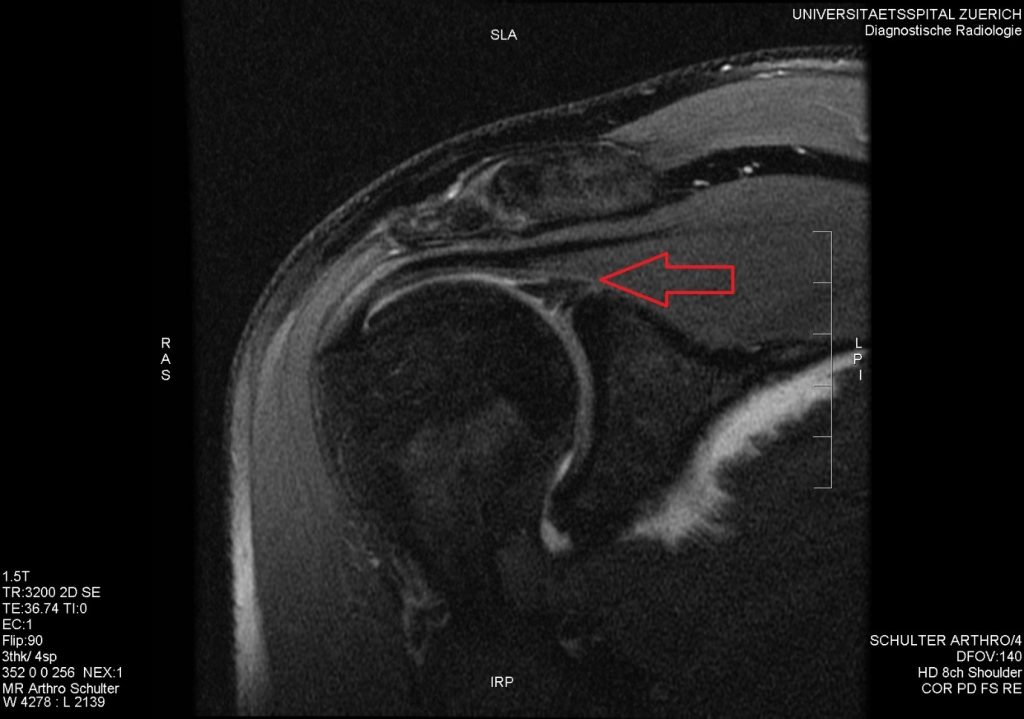
MRI of a SLAP tear (author: RSatUSZ; source: WikiMedia Commons)
Causes of Glenoid Labral Tear
The glenoid labrum also serves as an anchor for the tendon of the Long Head of the Biceps muscle. Most SLAP tears also involve the detachment of the biceps tendon from its anchor point – a type II SLAP lesion.
Possible mechanisms of injury involve:
- Falls on an outstretched hand (common)
- Traction injury (common), where the upper arm is pulled away from the shoulder
- Repetitive throwing and overhead activities
- Shoulder hyperextension
- Heavy lifting
- Direct trauma
Treatment of Glenoid Labral Tear
Unfortunately, most patients will not achieve a good result with conservative (non-surgical) management for glenoid labral tears. The labrum has poor abilities to heal due to its lack of blood supply.
For patients who do not wish to undergo surgery, a conservative treatment approach may include the following:
- Rest from activities that aggravate the symptoms.
- Anti-inflammatory medication can help in reducing pain and allow physical treatment to commence sooner.
- Strength, stability and motion are the components of shoulder function that should be focused on during rehabilitation.
- Focused on strength and stability of the rotator cuff muscles, shoulder girdle, trunk, core and scapular musculature, restoring normal shoulder motion, and training to improve dynamic joint stability.
Post-surgery, physiotherapy aims to help the patient regain maximum range of motion, strength and control of the shoulder girdle, through progressive increases in motion, stretching and resistance training. Consult your skilled physio for a tailored program suited to your needs.
Wayne Wu
Student Physiotherapist
References
Dodson, C. C., & Altchek, D. W. (2009). SLAP lesions: an update on recognition and treatment. J Orthop Sports Phys Ther, 39(2), 71-80. doi: 10.2519/jospt.2009.2850
Ebraheim, N. (Producer). (2011). SLAP Tear Symptoms Diagnosis And Treatment – Everything You Need To Know – Dr. Nabil Ebraheim. [Video] Retrieved from https://www.youtube.com/watch?v=dzFyLuyiIAE
Van de Weghe, I., Lowe, R., Sartore, K., O’Reilly, N., & Wauters, J. (n.d.). SLAP Lesion Retrieved December 07, 2016, from http://www.physio-pedia.com/SLAP_Lesion